

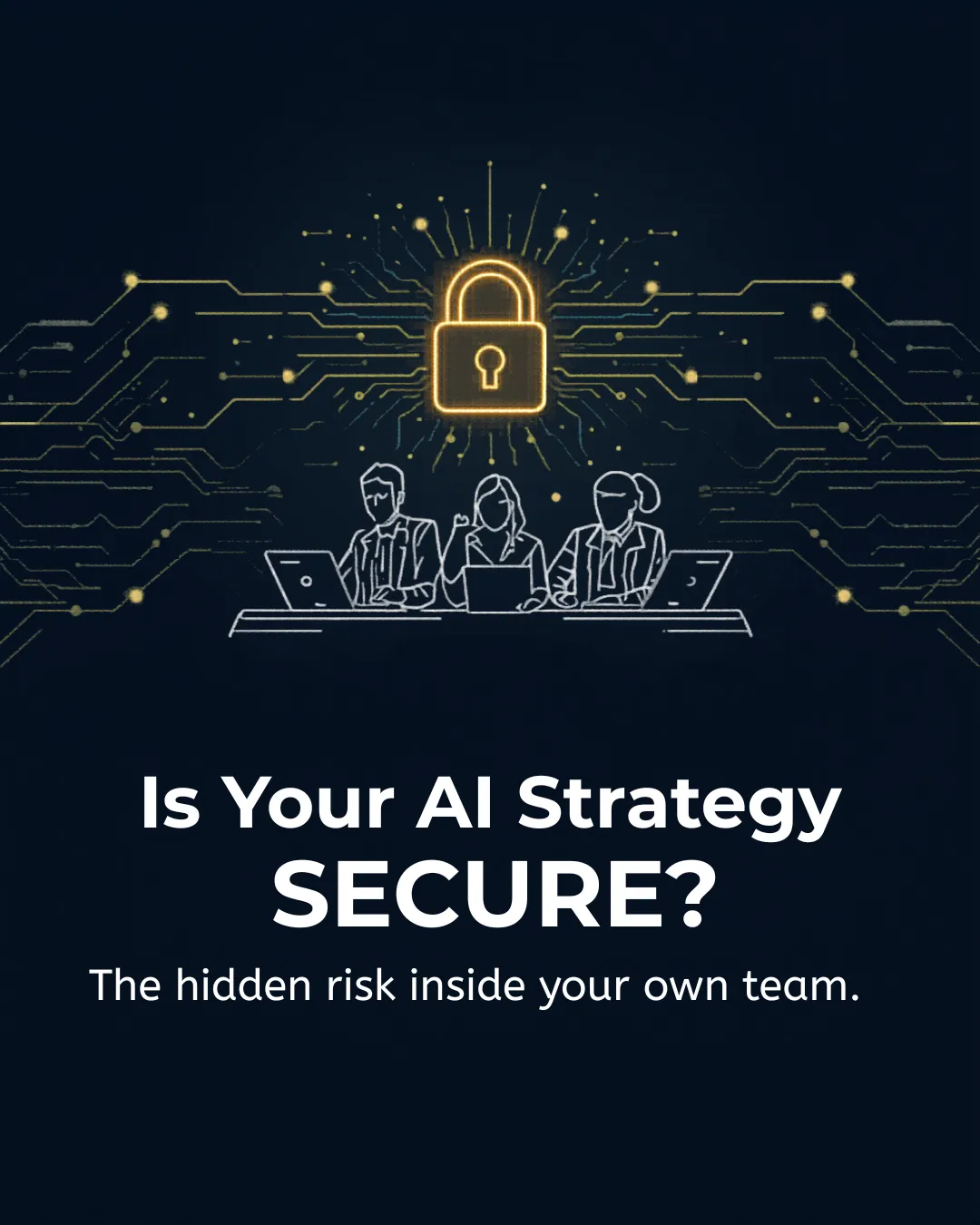
Your Employees Are Working Against Your AI Strategy
A Comprehensive AI Policy Is the Fix Nobody Wants to Write
Let’s start with an uncomfortable number: 44%.
That’s the percentage of Gen Z workers who, according to a recent survey by enterprise AI firm Writer and Workplace Intelligence, admit to actively sabotaging their company’s AI rollout. And before you chalk that up to generational tech resistance, the overall number across all employees sits at 29%. Nearly one in three of your people.
What does “sabotage” look like in practice? Entering proprietary data into unapproved public AI tools. Refusing to use AI tools at all. Intentionally generating low-quality outputs to make AI look ineffective. Knowing about an AI-related security incident and not reporting it.
That last one should get your attention - because that’s not just a productivity problem. That’s a security incident.
Why This Is Happening
The survey found that 30% of saboteurs cite fear of job loss as their primary motivation. Researchers are calling it “FOBO” - Fear of Becoming Obsolete. And while that might feel like an HR issue, it has real operational and security consequences for your business.
Here’s the cruel irony: the workers most resistant to AI adoption are statistically the most likely to be laid off because of it. Meanwhile, AI “super-users” are saving nearly 9 hours per week and are 3x more likely to have been promoted in the past year.
The fear is also compounded by a real disconnect between leadership and the workforce. Nearly 90% of executives believe their organization has a clear generative AI strategy. Only 57% of employees agree. That gap - over 30 points - is where chaos lives. And where security risks are born.
The Security Problem Nobody’s Talking About
When employees use unapproved AI tools, especially public ones, to process company information, they are creating data exposure risks that most SMBs have no visibility into. This is shadow IT at its most dangerous - and it’s happening right now, at scale, in organizations everywhere.
Consider what gets typed into these tools:
Client proposals and pricing
Internal HR and performance data
Strategic plans and financial projections
Customer PII and contact records
Proprietary processes and trade secrets
Once that data hits a public AI tool, you’ve potentially lost control of it. You may not know it happened. You may not be able to remediate it. And depending on your industry, you may have just violated a compliance requirement.
This is why “no AI policy” is itself a policy - and a bad one.
The Beehive Method™ Perspective
Step 3 of The Beehive Method is Education - training your team on compliance, security, AI, and automation essentials. Without this step, every other investment in AI tooling is built on sand. An AI policy without education is just a document nobody reads.
What a Comprehensive AI Policy Actually Covers
Most businesses either have no AI policy, or they have a vague one-pager that nobody has read since it was distributed. A comprehensive AI policy is a living governance document. Here’s what it needs to address:
1. Approved Tools and Platforms
Your policy needs to define exactly which AI tools are authorized for business use - and which are explicitly off-limits. This includes consumer-grade tools like ChatGPT, Claude, Gemini, and Copilot. The question isn’t whether your employees are using these tools. They are. The question is whether you’re governing how.
2. Data Classification and Handling Rules
Not all data is created equal. Your AI policy needs to map your data classifications (public, internal, confidential, restricted) to clear rules about what can and cannot be entered into any AI system. A client’s name might be fine. Their financial records are not.
3. Acceptable Use Guidelines
What business functions can AI assist with? What outputs require human review before use? What’s the standard for disclosing AI-generated content to clients or partners? These aren’t philosophical questions - they’re operational ones that need clear answers.
4. Incident Reporting Procedures
Remember that 16% of workers who knew about an AI security incident and said nothing? Your policy needs to make reporting easy, non-punitive, and expected. Build a clear process. Normalize transparency. Silence is not neutral - it’s a liability.
5. Training and Onboarding Requirements
Policy without training is theater. Every employee who touches an AI tool - approved or otherwise - needs baseline training on your AI governance framework, data handling expectations, and how to recognize a potential incident. This isn’t a one-time event; it’s an ongoing practice.
6. Accountability and Enforcement
Who owns AI governance in your organization? Who reviews incidents? What are the consequences for policy violations? Lack of clarity here is what the research identified as “tearing companies apart.” Define ownership. Establish accountability. Communicate both.
7. Review and Update Cadence
The AI landscape is evolving faster than most compliance frameworks can track. Your AI policy should have a defined review cycle - at minimum annually, and ideally quarterly - with a responsible owner who monitors regulatory changes, new tools, and emerging risks.
The SMB Reality Check
You might be thinking: “This sounds like enterprise-level stuff. We’re a small team.”
Here’s the reality: small and medium businesses are disproportionately affected by AI governance failures because they have less redundancy, fewer resources for incident response, and often more concentrated exposure to specific clients or sectors. A single data exposure event can cost you a customer relationship, a compliance certification, or your reputation.
The good news is that building a solid AI policy doesn’t require a team of lawyers or a six-figure compliance consultant. It requires a clear-eyed assessment of how AI is being used in your organization today - approved or not - and a practical framework for bringing that usage into governance.
It also requires leadership. The research is clear: employees who feel their AI concerns are dismissed or ignored are far more likely to go rogue. Building your policy collaboratively, communicating the ‘why’ behind it, and pairing it with genuine upskilling is how you turn resistors into adopters.
Where to Start
If you don’t have an AI policy today, here’s a simple starting framework:
Audit what AI tools your team is already using - with or without approval
Identify the data types most likely to be exposed through those tools
Draft a short, plain-language acceptable use policy and share it with your team
Train your team - don’t just circulate a document
Establish a reporting process for AI-related incidents
Schedule a quarterly review to keep the policy current
Done is better than perfect when the alternative is no governance at all.
The Bottom Line
The Gen Z sabotage headline is attention-grabbing, but the real story is simpler: when employees don’t understand the rules, don’t trust leadership’s AI strategy, or feel their job security is threatened, they act in their own self-interest. That’s human nature - and it’s been true since the Luddites.
A comprehensive AI policy doesn’t just protect your data. It protects your people. It creates clarity where there is confusion, accountability where there is drift, and a foundation where there is chaos.
If this resonates, the next step is understanding your own data foundation. Busy Bee: Baseline was built for exactly this — six weeks to map your data and build the clarity AI actually requires. Learn more →
Your employees aren’t your adversaries. But without proper governance, they might accidentally act like them.
Ready to Build Your AI Policy?
Bees Computing helps SMBs build practical AI and security governance frameworks - without the enterprise price tag. Start with our free Cyber Soft Target Diagnostic, or reach out to schedule a consultation.
Sources: Writer & Workplace Intelligence Survey (2026), Fortune, Inc., Fast Company, Goldman Sachs U.S. Daily (April 2026). This post is for informational purposes only and does not constitute legal or compliance advice.