

The Hidden Risk of MSPs - Part 2
The Hidden Risk of MSPs: Why Outsourcing IT Without a Risk Strategy Is a Business Liability (and How AI Makes It Worse)
Part 2
AI Changes the Game and Raises the Stakes
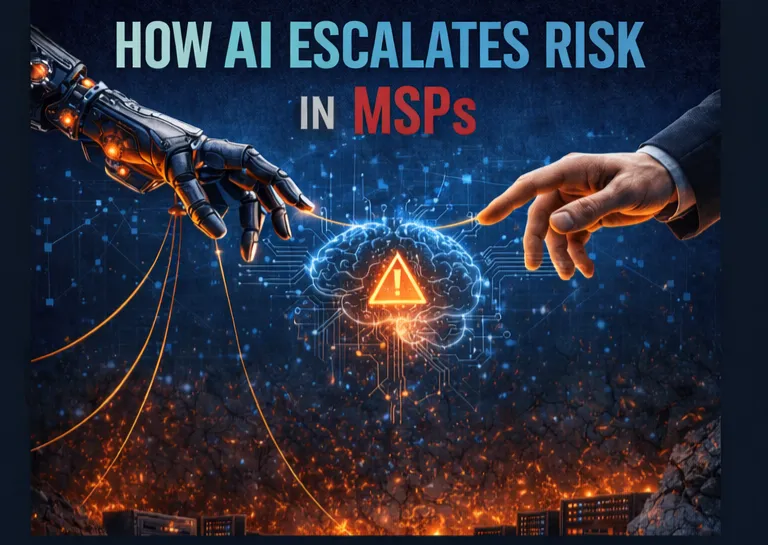
If MSPs reshape risk, AI accelerates it. AI is rapidly being embedded into MSP operations across the delivery chain:
Incident triage and initial classification
Automated remediation of known issue patterns
Infrastructure monitoring and anomaly detection
Knowledge generation and article drafting
Change risk scoring and approval routing
These capabilities are real. They create genuine operational value. And they introduce a new dimension of risk that organizations need to account for — not because AI is inherently dangerous, but because AI amplifies whatever conditions already exist in the operating model.
The NIST AI Risk Management Framework identifies key governance concerns: lack of explainability, data dependency risk, and the absence of defined accountability for model-driven decisions. In an MSP context, these translate to a straightforward question: when an automated decision is made in your environment, who owns the outcome, and how is it validated?
If the answer isn't clear, the AI isn't the problem. The governance gap is.
How AI Amplifies Existing Risk
Control Risk → Algorithmic Control Loss
You're no longer just trusting a provider; you are trusting their models, their training data, and the decisions those models make in your environment.
When AI-assisted decisions lack explainability, governance breaks down. Not dramatically, and not all at once, but incrementally. Decisions get made that no one can fully reconstruct. Patterns get established that no one explicitly designed. And the further you get from explainable decision-making, the harder it becomes to audit, correct, or govern what's happening.
If decisions in your environment can't be explained, they can't be governed. That's not a technology constraint; it's a governance requirement that AI creates.
Dependency Risk → Model Dependency
Beyond your dependency on the MSP, you now depend on AI models embedded in their tooling, the training data those models were built on, and third-party AI services and APIs that the MSP relies on.
These dependencies are rarely documented in the service scope. They are rarely tested in continuity scenarios. And yet they sit in the middle of your operational decision-making.
An AI model that is unavailable, degraded, or producing inaccurate outputs can affect triage accuracy, remediation quality, and change risk assessment, all without any visible failure in the traditional sense. The MSP's service appears to be running. The AI's contribution has quietly declined.
Dependency mapping in a modern MSP environment has to include the AI layer.
Knowledge Risk → Synthetic Knowledge
AI-generated knowledge can be produced quickly, consistently formatted, and broadly distributed. It can also be incomplete, factually incorrect, or missing the operational nuance that only surfaces when someone has actually worked through a problem at 2 AM.
Without a validation layer, human review, quality standards, and ownership structures, an organization's knowledge base can become faster to build and less reliable to use. That's not a step forward. It's a tradeoff that most organizations don't realize they're making.
AI accelerates knowledge creation. Governance determines whether what's created is actually useful.
Change Risk → Machine-Accelerated Failure
AI increases the speed at which decisions are made and actions are taken. In a well-governed change environment, speed is an advantage: lower latency, faster approvals for low-risk changes, better resource allocation.
In a change environment with gaps in oversight or accountability, speed compounds risk. A bad decision executed faster is still a bad decision that is just harder to stop.
The same discipline that change management applies to human decision-making needs to be applied to AI-assisted decision-making. The questions are the same: What is changing? What is the risk? Who authorized it? What's the rollback plan?
Accountability Risk → Diffused at Scale
In a traditional MSP model, accountability can be diffuse. In an AI-enabled MSP model, that diffusion happens faster and at a greater scale.
Who owns the outcome of an AI-assisted triage decision that routed a ticket incorrectly? Who owns the output of an AI-generated knowledge article that contained an error? Who owns the change risk score that an AI model assigned and that a human approved without fully reviewing?
Regulatory trends, including the EU AI Act's push for traceability and human oversight of consequential decisions, are already establishing that accountability for AI-assisted decisions cannot be diffused. It has to be assigned. Most MSP governance models aren't designed for that, yet.
What a Modern MSP Strategy Requires
If you're working with an MSP today, or evaluating one, your approach has to go beyond the operational metrics and the contract terms.
1. Treat the MSP engagement as a risk transformation, not a vendor decision. Due diligence includes governance mapping. Before you sign, you should be able to answer: who makes decisions in an incident, what knowledge will remain in organizational systems, and what does the exit scenario look like?
2. Embed governance into ITSM processes, not just contracts. Change management, problem management, and knowledge management are organizational functions. They may be supported by the MSP, but they cannot be delegated to them. Your organization needs active participation in each.
3. Measure risk alongside performance. SLA dashboards tell one part of the story. Dependency audits, knowledge ownership reviews, accountability testing, and governance health checks tell the rest. Build both into your oversight model.
4. Establish AI transparency and control mechanisms. Understand what AI capabilities your MSP is using, where those tools are influencing decisions in your environment, and what the validation and override mechanisms are. That is a governance requirement, not a technical nice-to-have.
5. Design for exit on day one. This is not pessimism. It is maturity. An organization that cannot recover its operational capability without its MSP has not outsourced execution; it has outsourced continuity. That's a different category of risk, and it starts to accumulate from the moment the relationship begins.
Final Thought
An MSP can elevate your organization. Or it can quietly increase your exposure - not through failure, but through the slow accumulation of governance gaps that no one fully defined, no one fully mapped, and no one fully tested until something went wrong.
AI will accelerate whichever path you've chosen.
Because if you didn't design for risk, you didn't design at all.