



Multi-Vendor Environments Are Designed to Fail Without Governance
There is a common assumption in IT strategy: more vendors equals less risk.
On paper, it makes sense. You avoid single-vendor dependency, gain flexibility, and reduce concentration risk. Sourcing strategies built on this logic are widely endorsed and in many ways, structurally sound. In reality, most multi-vendor environments don't reduce risk. They repackage it into coordination failure.
Where It Breaks
The moment you introduce multiple MSPs or vendors, you introduce a new category of risk: integration risk. Not technical integration, operational integration. Because when something breaks, the problem is no longer just technical. It becomes organizational.
You've probably seen it:
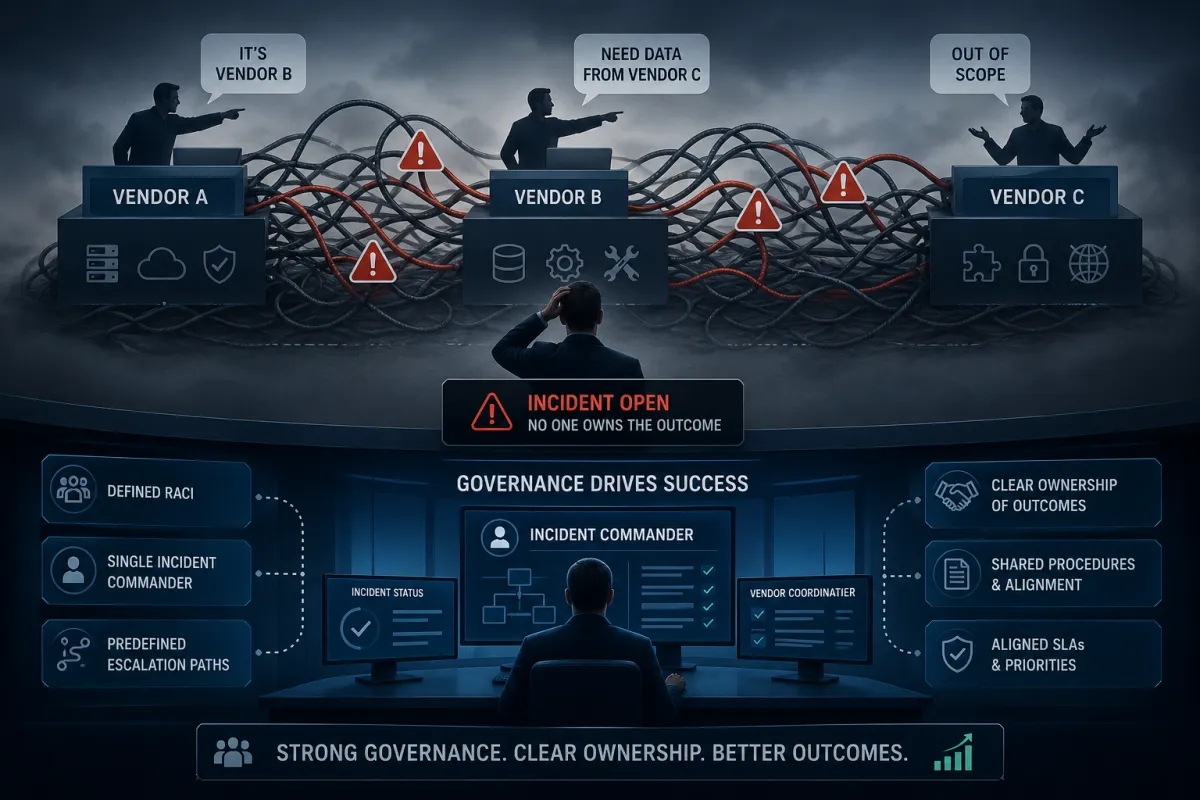
Vendor A points to Vendor B
Vendor B asks for logs from Vendor C
Vendor C says it's outside their scope
Internal teams try to piece it together
Meanwhile, the incident is still open. No one owns the outcome.
The Hidden Failure Mode
Most organizations design multi-vendor environments around capability. Very few design them around accountability. That's the gap. Each vendor has a contract, a scope, a toolset, and an SLA. But no one owns the end-to-end service outcome. So when a cross-system issue occurs, which is where most real incidents live, everything slows down.
Not because people aren't capable. Because the operating model is unclear.
Why Incidents Stall
In multi-vendor environments without governance, incidents don't fail loudly. They stall.
Delays in triage because ownership is unclear
Repeated data requests across vendors
Escalations that go sideways instead of upward
Conflicting priorities between providers
Internal teams acting as unplanned intermediaries
At that point, your organization becomes the integration layer. That was never the intention. But it becomes the reality.
What's Missing
Multi-vendor models only work when governance is stronger than the complexity they introduce. At a minimum, that means:
A defined RACI across all vendors, not just within each one.
A single incident commander for major incidents regardless of which vendor is in scope.
Predefined escalation paths that cross vendor boundaries.
Clear ownership of end-to-end service outcomes.
Shared operating procedures for incident, change, and problem management.
Aligned SLAs and priorities across all providers.
Without these, every incident becomes a negotiation instead of a response.
The Cost of Getting It Wrong
The impact isn't always visible in reports. It shows up in:
Increased mean time to resolution (MTTR).
Repeated incidents that never fully close.
Friction between vendors and internal teams.
Loss of confidence from the business.
Slower recovery during critical events.
In short: service quality degrades. Quietly at first. Then consistently.
Governance Is Not Optional
Multi-vendor environments can work. But only when governance is treated as a core capability, not an afterthought bolted on after the vendor contracts are signed.
Vendors manage services. You are still accountable for outcomes.
That distinction matters enormously. A vendor's SLA measures their performance on their scope. It does not measure whether your end-to-end service is functioning. Those are different things, and only one of them has an owner by default.
Building governance into a multi-vendor model means:
Designing the operating model before scaling vendors, not after.
Assigning clear accountability, not just responsibility, for outcomes.
Establishing a central authority for incident coordination.
Holding vendors accountable to shared outcomes, not isolated tasks.
A Simple Leadership Test
Ask this: when a cross-vendor incident occurs, who is accountable for resolution, not just their piece of it?
If the answer is unclear, the risk is already present. This isn't a hypothetical. It's a question worth answering before the next major incident answers it for you.
Final Thought
Multi-vendor environments are not inherently flawed. Distributing capability across specialized providers is a legitimate and often effective strategy when governance keeps pace with the complexity it introduces.
Without clear ownership, defined coordination, and aligned accountability, complexity wins. And when complexity wins, service suffers; not because your vendors failed, but because your operating model left no one responsible for the seams between them.
Design the governance before you scale the vendors. The alternative is building an environment where failure isn't a risk, it's an architecture decision you made by omission.