



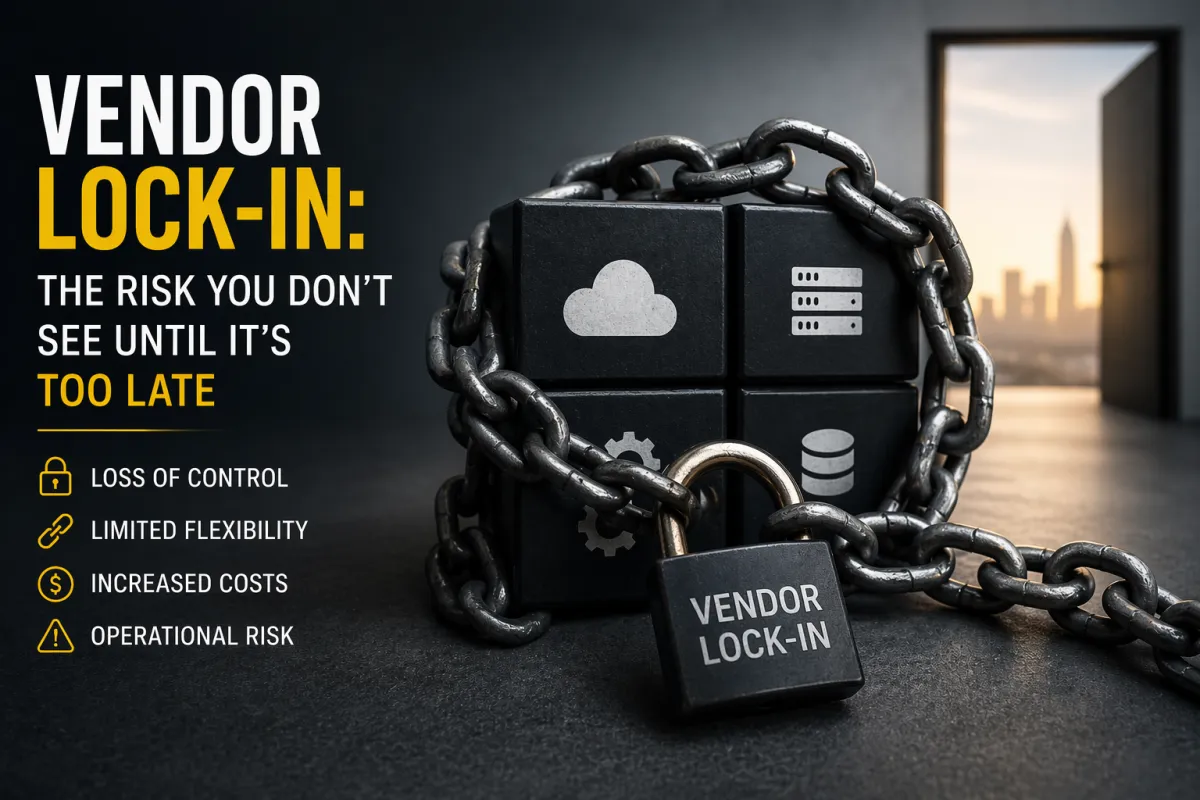
Vendor Lock-In: The Risk You Don't See Until It's Too Late
Many organizations hear the term vendor lock-in and immediately think about pricing. That is part of it, but it is not the real issue. The bigger problem is loss of control.
Vendor lock-in becomes dangerous when an organization realizes that critical parts of its operations are tied to a provider in ways that are difficult, expensive, or disruptive to unwind. It is less about contracts and more about dependency, and dependency, left unmanaged, quietly becomes a strategic liability.
This is especially common in managed services environments, where convenience often becomes the gateway to long-term risk.
What Vendor Lock-In Actually Looks Like
Vendor lock-in is not always dramatic. It usually develops quietly over time. It is the result of accumulated decisions that each seemed reasonable when they were made.
It can look like:
Administrative accounts owned or managed solely by the provider.
Monitoring, backup, or security tools that cannot easily be transferred.
Documentation stored in systems the client cannot directly access.
Custom workflows or automations no one internally understands.
Critical operational knowledge concentrated entirely outside the organization.
NPI Financial notes that lock-in can take several distinct forms: technical, contractual, financial, and operational, and that while it may begin with a well-intentioned technology deployment, it often evolves into a long-term dependency with limited strategic flexibility. What starts as an efficient arrangement can quietly reshape the balance of power in a vendor relationship.
At first, these arrangements may feel efficient. They reduce the immediate workload. They simplify operations. The provider handles the complexity so your team doesn't have to.
Until something changes.
When the Risk Becomes Visible
Lock-in often stays hidden until the organization needs flexibility. That moment usually arrives during one of these scenarios:
A decline in service quality.
A cybersecurity incident.
A pricing dispute or contract renewal.
A merger or acquisition.
An internal transformation or modernization initiative.
The decision to transition to a new provider.
At that point, many organizations discover they cannot move quickly because too much control sits outside the business. IBM identifies this directly: vendor lock-in causes organizations to risk becoming overly dependent on a single provider's proprietary services, APIs, and pricing models, limiting flexibility and causing costs to increase over time. Transitioning away can involve complex re-architecture efforts, data migration challenges, and a significant financial burden.
The numbers reinforce the concern. IDC research indicates that data migration projects frequently exceed their original budgets by 30% or more due to unforeseen complexity. That is a material cost, and it does not account for the operational disruption, the staff time, or the service continuity risk that accompanies a forced transition.
The Synapse Financial Technologies bankruptcy highlighted a serious concentration-risk issue: when one third party becomes the critical source for ledgering, reconciliation data, or core service operations, failure at that provider can cascade into customer-impacting disruption. It is a reminder that single-provider dependence can create a dangerous single point of failure. As the Disaster Recovery Journal has noted, single-provider dependence means a single potential point of failure, full stop.
Why This Matters Beyond Cost
Vendor lock-in is often treated as a procurement issue. It is better understood as a risk management issue. The financial dimension is real: switching costs, egress fees, re-architecture expenses, and renegotiation pressure. But the operational and security dimensions are often underappreciated until they become urgent.
NCC Group has documented this clearly. Vendor lock-in creates systemic vulnerabilities, stifles innovation, and positions organizations to absorb risk they never agreed to take on. When a single provider controls compute, storage, identity and access, monitoring, and data management simultaneously, resilience is fundamentally compromised. That is not a vendor relationship; that is a dependency with a contract attached.
When control is concentrated externally, organizations may face:
Slower incident response because the provider, not the client, holds the diagnostic access.
Longer recovery timelines because the knowledge required to act is not resident in-house.
Reduced negotiating leverage because the cost of leaving is prohibitive.
Higher transition costs compounding over time with every new integration.
Limited strategic agility because the organization's roadmap becomes hostage to the vendor's.
Increased operational disruption during change because exit readiness was never built in.
In short, the business becomes less resilient. And resilience, not efficiency, is what determines whether an organization can respond when things go wrong.
McKinsey has also found that companies adopting multi-cloud and multi-vendor strategies improve innovation speed by up to 20%, partly because they avoid the stagnation that single-vendor lock-in creates when the provider's roadmap diverges from the client's actual needs.
The Hidden Layer: Knowledge Lock-In
Beyond systems and tooling, there is a less discussed, and arguably more dangerous, form of dependency: knowledge lock-in. When the operational knowledge that keeps your environment running lives entirely inside your provider's team, you do not just face a technology migration challenge. You face a capability gap.
This surfaces in several ways. Runbooks and standard operating procedures that exist only in the provider's systems. Monitoring thresholds and escalation logic that no one on the client side has ever reviewed. Custom automations built by engineers who have long since moved to other accounts. Institutional knowledge about your own environment that you cannot access without filing a service request.
Technical lock-in traps your data, but cultural lock-in traps your people. Familiarity bias sustains dependency long after the contract should have evolved. Organizations that embed independence into their governance culture are far better positioned to respond when they need to.
This is why exit readiness is not just a legal or procurement concept. It is an operational one.
What Strong Governance Looks Like
Good providers should not fear transparency. Strong vendor relationships are built on capability and trust, not on dependency. The most resilient arrangements are those designed with the assumption that circumstances can change, and that the client retains meaningful control throughout.
Organizations should expect, and contractually require, the following:
Client-owned privileged access: administrative credentials belong to the organization, not the provider.
Clear documentation ownership: all operational documentation is held in systems the client can directly access, not only the provider's internal platforms.
Defined exit and transition procedures: transition plans documented from the outset, not negotiated under pressure at the end.
Portable tooling where practical: monitoring, alerting, and backup tools selected with transferability in mind.
Regular governance reviews of dependencies and risks: periodic assessments of where concentration has grown, not one-time due diligence at contract signing.
Shared accountability for resilience and security: the provider is a partner in business continuity, not the sole owner of it.
Industry analysts consistently report that many enterprises underestimate the number of applications and integrations operating across their environment, limiting governance and increasing dependency risk. This makes exit planning difficult and allows hidden vendor entrenchment to take root. Organizations that proactively track where and how vendors are embedded across infrastructure, workflows, and data flows are significantly better positioned to avoid long-term lock-in.
If the governance basics above are missing from a current relationship, that relationship may be delivering convenience today while building exposure tomorrow.
A Simple Test
Ask one question:
If we needed to transition away from this provider in the next 30 to 60 days, could we do it without significant disruption?
If the honest answer is no or if the answer is uncertain, there is risk that needs to be addressed. Not eventually. Now.
A practical follow-on: ask to see the transition plan. Every mature vendor relationship should have one. If your provider does not have a documented exit and transition process, that absence is itself a signal worth taking seriously.
What to Do About It
Addressing vendor lock-in does not require ending otherwise productive relationships. It requires governing them more deliberately. Start with a dependency audit. Map where a single provider holds control across multiple dimensions: access, tooling, data, documentation, and operational knowledge. Concentration across more than two or three of these dimensions warrants attention.
Then address the contractual layer. Agreements should include enforceable data export SLAs, termination-for-convenience provisions, clear transition assistance obligations, and defined knowledge transfer requirements. These protections are far easier to negotiate at the start of a relationship than to extract at the end.
Finally, build exit readiness into the operating model. Conduct internal training. Maintain internal documentation. Run periodic transition simulations; not because you plan to leave, but because knowing that you can leave is what gives you the leverage to negotiate as a partner rather than as a captive.
Final Thought
Vendor lock-in rarely announces itself early.
It usually becomes obvious when an organization needs options and discovers it has very few. By that point, the cost of addressing it is far higher than the cost of preventing it would have been. The best time to address dependency risk is before it becomes urgent. The second-best time is now.
Because outsourcing a service should never mean outsourcing control.