



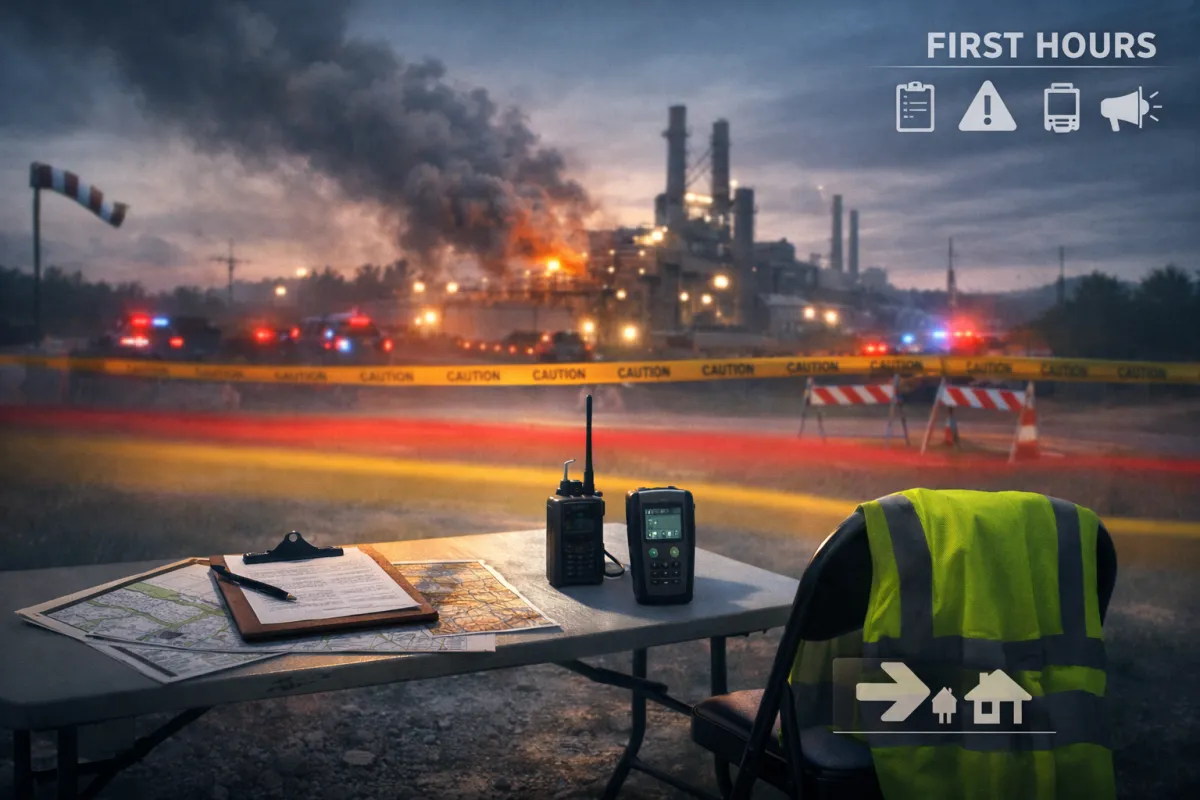
China Plant Explosion: First Hours of Incident Command
When the scene is still unstable, command discipline is the difference between coordinated response and cascading harm.
By Aaron Gilmore — Intergalactic SEM Consultant (humans only so far).
Human Lead, Automation-Enhanced. SEM-Artificium
QuickScan
In the first hours after an industrial chemical explosion, responders must assume multiple hazards: fire, toxic release, secondary explosions, and structural instability.
The fastest value is not “more responders”—it’s a clear Incident Command structure, hot/warm/cold zoning, and disciplined access control.
Protective actions (shelter-in-place vs evacuation) must be driven by monitoring data, plume behavior, and the ability to move people safely.
Public messaging should be early, calm, and repeatable: what to do, where to get updates, and what NOT to do.
Document decisions as they happen (what was known, what was assumed, who approved). That log becomes your AAR backbone.
For Who Primary audience: DoD/Federal Supply Chain
Also useful for: Industrial site leadership, security, EHS, emergency management, and third-party/supplier risk teams.
What You’ll Get
You will learn: The “first-hours” priorities for industrial incident command after a chemical explosion.
You will be able to do: Use a First-Hours Command Checklist to stand up control zones, assign roles, and issue protective-action messaging.
Time & Effort Read time: 8–9 minutes
Do time (optional): 30–60 minutes
Difficulty: Intermediate
First-hour incident command is about controlling the scene, not chasing the smoke.
Executive Snapshot
What happened: On May 27, 2025, a major explosion at a chemical plant in Gaomi (under Weifang), Shandong Province, China generated large smoke plumes, caused fatalities and injuries, and triggered a large fire/rescue response and environmental monitoring. Early public reporting cited at least five deaths, 19 injuries, and six missing, with community impacts including damage to nearby buildings and precautionary measures reported for nearby residents/schools. (Associated Press, 2025a; Reuters, 2025a)
Why it matters: Industrial chemical explosions create a “first-hours” leadership problem: life safety, HazMat uncertainty, perimeter control, and public trust all collide before the facts are fully known. The first operational period is where secondary harm happens—untracked responders, spontaneous crowd convergence, conflicting protective-action guidance, and rumor-driven behavior. A disciplined incident command posture reduces cascading risk even while root-cause and chemical specifics remain uncertain. (FEMA, 2017; NFPA, 2022a)
What to do now:
Pre-design your first-hour HazMat explosion playbook: who becomes IC, how zones are established, who decides shelter-in-place vs evacuation, and what triggers change those decisions. (FEMA, 2017)
Treat public information as an operational function: one message owner, one cadence, one “truth channel,” and a decision log that captures what was known/assumed at the time. (FEMA, 2017)
Treat supplier industrial incidents as supply chain incidents: activate a supplier situation-report (SITREP) intake pathway within the first 24 hours (safety status, production impact, contamination risk, ETA, alternates). (Associated Press, 2025a)
Key lesson: In the first hours, success looks like perimeter control + protective actions + credible public messaging + unified responder coordination—even before you know the full cause.
Field Notes Opening
From far away, a blast scene looks like a single problem: fire and smoke. Up close, it’s a pile-up of problems. People are moving toward danger to film it. Others are trying to drive away through the same roads responders need. A nearby school wants a single sentence: “Do we evacuate?” Families want certainty. Leadership wants a timeline. And the chemistry is still a mystery.
In the first hour, you rarely have the perfect answer.
But you can still have something better than certainty: Clear actions. Clear boundaries. Clear updates.
What We Know (Verified Facts)
Confirmed facts:
The explosion occurred around 11:57 a.m. local time on May 27, 2025 at a chemical plant reported as operated by Shandong Youdao Chemical in Gaomi (Weifang), Shandong Province, China. (Reuters, 2025a)
Early reporting cited at least five fatalities, 19 injured, and six missing. (Associated Press, 2025a; Reuters, 2025a)
Public reporting described significant smoke plumes and damage to nearby buildings/windows. (Associated Press, 2025a)
Reporting indicated a large emergency response, with hundreds of responders referenced in early coverage. (Reuters, 2025a)
Reporting indicated environmental monitoring activity and that some community members (including a nearby school) took precautionary measures (e.g., masks) while air-quality outcomes were still forming. (Associated Press, 2025a; Reuters, 2025a)
Reporting indicated higher-level attention to the investigation (e.g., State Council Work Safety Committee oversight reported by China Daily). (China Daily, 2025)
Field note: These details are sufficient to extract doctrine lessons about “first hours” command priorities, even if root-cause and full chemical specifics remain undisclosed.
What We Don’t Know Yet (Unverified / Evolving)
Open questions / uncertain details:
The initiating cause (process failure, equipment failure, maintenance error, human factors, etc.).
The chemicals involved and whether any secondary releases occurred.
Verified air-quality results, exposure pathways, and health guidance beyond initial precautions.
Final casualty/missing accounting and longer-term community impacts.
Assumptions used in this article:
Because public reporting described a chemical plant with significant smoke and community concerns, we assume non-trivial HazMat potential until confirmed otherwise.
We assume first-hours challenges included standard HazMat command problems: plume uncertainty, crowd control pressure, responder safety, and rumor dynamics.
Timeline
~11:57 a.m., May 27, 2025 — Explosion occurs at chemical plant in Gaomi (Weifang), Shandong. (Reuters, 2025a)
First hour — Large response mobilizes; casualty/missing/injury picture begins to form; perimeter and protective-action posture must be set quickly. (Associated Press, 2025a)
Same day — Environmental monitoring activity is reported; community precautions are reported (e.g., mask use at a nearby school). (Associated Press, 2025a)
Following day(s) — Continued response and investigation; higher-level oversight of the investigation is reported. (China Daily, 2025; Reuters, 2025b)

Figure 1 - "First Hours Timeline — Industrial Chemical Explosion (0–4 Hours) [Aaron Gilmore] {Timeline strip showing first-hours incident command priorities for an industrial chemical explosion across 0–15 minutes, 15–60 minutes, and 1–4 hours.}
Why This Matters (So What?)
For DoD/Federal supply chain leaders:
Industrial incidents at overseas suppliers can disrupt the industrial base, create upstream shortages, and trigger urgent questions about worker safety, production shutdowns, contamination risk, and alternate sourcing.
In a crisis, leaders need a structured way to request and validate supplier status—especially when the supplier is operating under their own emergency command and information is incomplete. (Associated Press, 2025a)
For any organization with industrial hazards:
Chemical explosions are multi-domain incidents: life safety, environmental exposure, security perimeter, public information, and continuity.
The first operational period often determines whether you prevent secondary injuries, protect responders, manage public behavior, and preserve credibility for the investigation and recovery. (NFPA, 2022a)
SEM Doctrine Translation
Doctrine focus:
Incident Command System (ICS) fundamentals: clear authority, objectives, communications, and resource coordination. (FEMA, 2017)
HazMat operational discipline: zoning, accountability, air monitoring, medical triage, protective actions. (NFPA, 2022b)
Public information management: one voice, consistent cadence, protective guidance, rumor control (JIS/JIC concepts). (FEMA, 2017)
Plain-English explanation: In the first hours of a chemical explosion, you are leading under uncertainty. You won’t have perfect chemical identification or a confirmed cause—yet you still must make decisions that prevent secondary harm.
ICS gives you the structure to do that: name an Incident Commander (IC), assign a Safety Officer, establish objectives (life safety, incident stabilization, environmental control, public protective actions), and control communications so the scene doesn’t fragment. (FEMA, 2017) HazMat discipline keeps responders and the public from becoming “additional casualties”: define hot/warm/cold zones, control entry, track accountability, and base protective actions on best-available monitoring and plume indicators, updating decisions as data improves. (NFPA, 2022b)
Public messaging is not “PR after the fact.” It is an operational control that shapes public behavior—reducing spontaneous convergence, rumor spread, and harmful self-evacuation. ICS emphasizes coordinated information systems (JIS/JIC) and repeatable update cadence: what is known, what is being done, what the public should do now, and when the next update will occur. (FEMA, 2017)
What “good” looks like in the first hours (four priorities):
Perimeter control (security + safety)
Good perimeter control is not “keeping people out.” It is controlling exposure, managing access, and preventing chaos.
Immediate exclusion zone with controlled entry points
Hot/Warm/Cold zoning (or equivalent) with clear markings
Traffic control points that prevent convergence and keep evacuation routes clear
Accountability for responders/contractors entering hazard areas
Documentation discipline (photos, logs, chain of custody where applicable)
Failure mode to avoid: Soft perimeter where bystanders get too close, responders become untracked, and routes clog.
Protective actions (shelter-in-place vs evacuation)
You won’t know everything about the plume early. You still have to choose.
Decision based on best available info: wind, visible plume, odor reports, facility SDS/chemical inventory (if accessible), and initial monitoring
Clear triggers: “If X happens, we shelter; if Y happens, we evacuate.”
Special attention to schools, hospitals, and vulnerable populations
Controlled re-entry criteria (don’t allow drift-back based on appearance)
Failure mode to avoid: Indecision that causes spontaneous self-evacuation and conflicting instructions.
Public messaging (credibility under uncertainty)
In the first hours, the public doesn’t need perfect answers. They need clear, repeated actions and honest uncertainty.
A single message owner and authoritative channel
A stable cadence (e.g., every 20–30 minutes early) with “known / doing / do now / next update time”
Health guidance: symptoms to watch for and where to seek care
Anti-rumor language: “If you see conflicting info, rely on these channels.”
Failure mode to avoid: Premature claims (“air is safe,” “no chemicals released”) that later get contradicted.
Responder coordination (unified objectives)
A chemical explosion response is inherently multi-agency.
·Unified objectives in plain language
·Structured resource requests (mutual aid, foam, monitoring equipment, EMS surge)
·A Safety Officer empowered to stop unsafe actions
Failure mode to avoid: Parallel command posts with inconsistent priorities.

Figure 2 - "HazMat Scene Control — Hot/Warm/Cold Zones + Access Control" [Aaron Gilmore] {Top-down diagram showing a chemical incident scene with hot, warm, and cold zones, a command post in the cold zone, a decon corridor, one controlled access control point, and an outer traffic control point with wind direction indicated. }
Lessons Learned (What this incident teaches)
Perimeter control is a life-safety control. The boundary is part of treatment.
Protective actions must be chosen early—even with imperfect data. The decision can be updated; the delay costs.
Public messaging is operational. Your comms team is a response team.
Air monitoring is only useful when results are communicated and tied to actions. “Testing is underway” must be paired with “what to do now.”
Supplier incidents are your incidents when you depend on them. Continuity plans must include how you obtain reliable situation reports quickly.
Role-Based Implications (Who should do what)
Incident Commander / Site Emergency Management:
Pre-assign roles: IC, Safety, Liaison, Public Information, Operations, Planning.
Use a short Incident Action Plan (IAP) mindset (objectives, hazards, comms plan, resources). (FEMA, 2019)
Security (physical/corporate):
Establish cordons, controlled entry, and traffic routing.
Coordinate with police for crowd control and controlled evacuation routes.
EHS / HazMat:
Provide chemical inventory and SDS access pathways.
Lead monitoring strategy and interpretation for protective-action decisions.
Public Affairs / Communications:
Maintain one truth channel, one cadence, one set of protective-action instructions.
Pre-stage templates: explosion, suspected chemical release, shelter-in-place, evacuation, school impacts.
Legal / Compliance:
Ensure communications and documentation meet regulatory/reporting obligations.
Preserve records for investigation and potential litigation.
Supply Chain / Vendor Management (DoD/Fed lens):
Maintain a “supplier incident intake” playbook: what to request in the first 24 hours (status, safety, production, contamination risk, ETA, alternates).
What To Do Now (Field Application)
First-Hours Industrial IC Quick Card (Checklist)
0–15 minutes
Establish IC and name a Safety Officer.
Set an initial exclusion zone and controlled entry.
Determine immediate protective-action posture: hold, shelter, evacuate (default bias toward life safety).
15–60 minutes
Confirm accountability (missing persons and responder tracking).
Activate unified command partners (fire/HazMat/EMS/police/environment + facility leadership).
Stand up a single public information cadence and authoritative channel.
1–4 hours
Refine zones and re-entry controls.
Expand monitoring and explicitly tie results to public actions.
Begin sustained operations planning (shift relief, mutual aid, logistics, evidence preservation).
Evidence to capture (decision log)
Capture, in real time:
Protective actions chosen and why (what was known vs assumed)
Resource requests and arrival times
Responder accountability and zone access logs
Monitoring results and interpretation used for decisions
Communications issued (timestamps, channel, content)
Incident timeline (key events)
“Done” criteria (end of first operational period)
Perimeter is stable and controlled.
Protective actions are clearly communicated and consistently enforced.
Unified objectives are written and shared.
A public update cadence is active and credible.

Figure 3 - First-Hours Industrial Incident Command — Quick Card [Aaron Gilmore] {One-page quick card checklist for the first hours of incident command after an industrial chemical explosion, organized into 0–15 minutes, 15–60 minutes, and 1–4 hours with an evidence/decision log band.}
Note from the Author
In the first hours, you’re not being judged on whether you solved the chemistry. You’re being judged on whether you controlled the scene, protected people, and communicated with discipline. That’s what incident command is: clarity under stress. Unfortunately new technology, especially in the energy/utilities/chemicals sector, tends to come with enhanced risks and dangers. Although risks like these are very rare, there is a reason these facilities have action plans specifically made ahead of time for events like these. Although the CCP has been very spars on detailed information they have allowed to be disseminated, from what I read in the public, they had a plan and followed it to the best of their ability. I can say this because the information that is publicly available shows they established an ICS and did make immediate important steps to contain the incident and then respond to mitigating its 3rd party effects, until it settled. Chemical plant fires are also common in the US unfortunately, and you can search engine this topic for US plants and see the absolute destruction they can cause, especially in the fires that last weeks and the explosions that cause their own earthquakes. There is a reason we have OSHA, and the low statistics for how often events at US facilities occur, demonstrates that industry regulations + polices + procedures work when followed, both in mitigation containment and in response impact.
Reference List
Associated Press. (2025a, May 27). At least 5 are dead and 19 injured after a chemical plant explodes in China, authorities say. AP News. https://apnews.com/article/china-chemical-plant-explosion-c6cf0f35f996654221e9fb8de7d9fcee
Associated Press. (2025b, May 28). A search continues for 6 people missing after a chemical plant explosion in China. AP News. https://apnews.com/article/a29043f2a620be7567e0840c6c57a6d4
China Daily. (2025, May 28). State Council oversees deadly Shandong chemical blast probe. https://www.chinadaily.com.cn/a/202505/28/WS6836fb0aa310a04af22c2104.html
Federal Emergency Management Agency. (2017, October). National Incident Management System (NIMS) (3rd ed.). https://preptoolkit.fema.gov/documents/4461741/40222908/National%2BIncident%2BManagement%2BSystem%2B%28NIMS%29%2C%2BThird%2BEdition%2C%2BOctober%2B2017..pdf
Federal Emergency Management Agency. (2019). ICS forms book (ICS 201, 202–206, 214). https://www.fema.gov/sites/default/files/2020-07/fema_ics-forms-booklet.pdf
National Fire Protection Association. (2022a). NFPA 1561: Standard on emergency services incident management system and command safety. https://www.nfpa.org/codes-and-standards/all-codes-and-standards/list-of-codes-and-standards/detail?code=1561
National Fire Protection Association. (2022b). NFPA 472 / NFPA 1072: Standards related to hazardous materials response competencies. https://www.nfpa.org/codes-and-standards
Reuters. (2025a, May 27). Large blast hits chemical plant in China’s Shandong; authorities race to respond. https://www.reuters.com/markets/emerging/large-blast-hits-chemical-plant-chinas-shandong-2025-05-27/
Reuters. (2025b, May 28). At least 5 dead, 6 missing after China chemical plant blast. https://www.reuters.com/markets/emerging/large-blast-hits-chemical-plant-chinas-shandong-2025-05-27/