



Nigeria Tanker Explosion: Crowd Risk & Scene Control
When bystanders rush toward fuel spills, the incident doubles: HazMat + crowd management.
By Aaron Gilmore — Intergalactic SEM Consultant (humans only so far).
Automation-Enhanced. SEM-Artificium
QuickScan
Fuel tanker crashes and leaks are time-compressed HazMat incidents—ignition risk can spike without warning.
Crowds turn a dangerous scene into a mass-casualty event; “curiosity” is a predictable hazard.
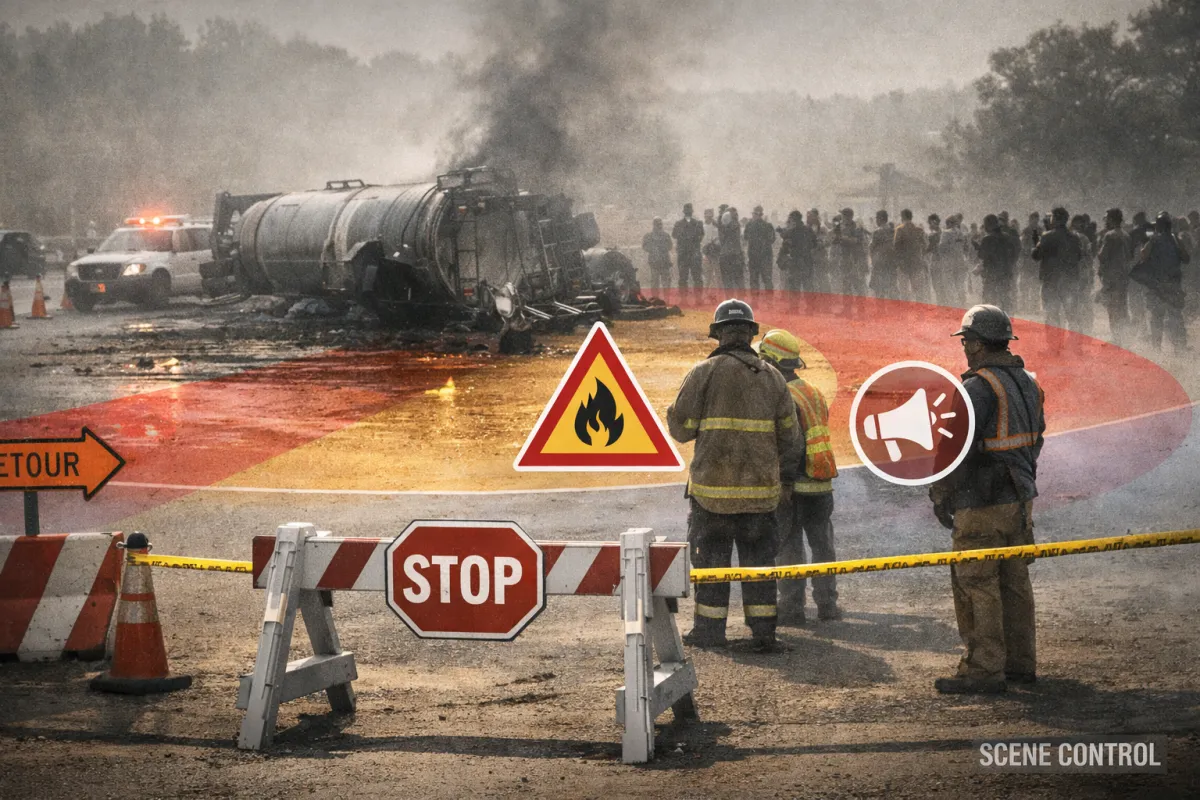
The fastest life-saving action is strict perimeter control: hot/warm/cold zones, traffic control points, and controlled access.
Public messaging must be immediate and blunt: stay back, do not collect fuel, follow protective-action instructions.
Use an Emergency Response Guidebook (ERG) posture early: isolate, deny entry, and expand only when hazards are understood.
For Who Primary audience: DoD/Federal Supply Chain
Also useful for: Transportation/logistics leaders, site security, EHS/HazMat, emergency management, public safety liaisons, and community-facing comms teams.
What You’ll Get
You will learn: Why crowd convergence is a leading cause of secondary casualties at tanker incidents.
You will be able to do: Use a Crowd-Convergence Control Checklist to set zones, control traffic, and issue protective-action messages in minutes.
Time & Effort Read time: 7–8 minutes
Do time (optional): 30–60 minutes
Difficulty: Beginner → Intermediate
The first boundary you set is the first life you save.
Executive Snapshot
What happened: On January 18, 2025, a fuel tanker crash and spill near Suleja in Niger State, Nigeria drew a large crowd to the scene; ignition led to a fire/explosion with mass casualties. Early reporting cited people collecting fuel and bystanders observing/taking pictures, with ignition linked to efforts to transfer fuel (including generator use). (Al Jazeera, 2025; Associated Press, 2025a)
Why it matters: Tanker incidents are time-compressed HazMat emergencies where “the material” and “the crowd” both become hazards. Crowd convergence turns a transport accident into a multi-casualty incident—so perimeter, access control, and public protective-action messaging are not optional add-ons; they are life-saving controls. (Pipeline and Hazardous Materials Safety Administration [PHMSA], 2024; Federal Emergency Management Agency [FEMA], 2017)
What to do now:
Treat crowds as a predictable hazard: establish hot/warm/cold zones, traffic control points, and a hard perimeter fast. (PHMSA, 2024)
Stand up a single voice early: issue blunt, repetitive protective-action messages (stay back; no fuel collection; follow instructions). (FEMA, 2020)
Use a closure tracker for response improvements: after-action findings must become implemented controls (training, comms, and scene-control procedures). (FEMA, 2017)
Key lesson: In fuel incidents, scene control is life-saving—and crowd control plus clear messaging must start immediately, before responders “solve the fire.”
Field Notes Opening
There’s a moment at a roadside spill when people lean forward. A few steps closer. A phone comes out. A bucket appears. And suddenly you’re not managing a crash—you’re managing human gravity. Because spilled fuel doesn’t just attract ignition. It attracts crowds.
Reader Promise: In a few minutes, you’ll understand how crowd convergence turns HazMat incidents into mass-casualty events—and what to do (fast) to control the scene.
What We Know (Verified Facts)
Confirmed facts:
The incident occurred on January 18, 2025 near Suleja in Niger State, Nigeria (Dikko Junction area along a major roadway). (Al Jazeera, 2025; Associated Press, 2025a)
Reporting described a large crowd approaching the scene after the crash/spill, including people attempting to collect fuel and others observing/taking pictures. (Associated Press, 2025a)
Reporting linked ignition to fuel-transfer efforts (including generator use), followed by fire/explosion. (Al Jazeera, 2025; Associated Press, 2025a)
Fatality reporting increased over subsequent updates; one widely reported update cited at least 86 deaths and 55 injured, while later reporting in some outlets indicated the toll may have risen further. (Al Jazeera, 2025; Associated Press, 2025a; Associated Press, 2025b)
Key actors / organizations involved:
Nigerian emergency management authorities (e.g., national/state agencies) and local responders.
Medical facilities receiving burn victims.
Community leaders and government officials issuing public warnings.
Field note: Exact counts can shift after severe burns and delayed recovery; the operational lesson does not depend on a precise final number.
What We Don’t Know Yet (Unverified / Evolving)
Open questions:
Detailed cause of the initial crash/overturn (speed, road condition, vehicle condition, loading)?
Exact ignition pathway and sequence of events during fuel transfer?
Final reconciled casualty counts and injury severity distribution?
Response timeline detail (first responder arrival times, perimeter establishment, comms effectiveness)?
Timeline
Jan 18, 2025 — Tanker incident → fuel spill → crowd convergence → ignition/fire/explosion reported. (Al Jazeera, 2025; Associated Press, 2025a)
Jan 19–20, 2025 — Updated casualty/injury reporting released by authorities and covered by major outlets. (Al Jazeera, 2025; Associated Press, 2025a)
Context — Similar Nigeria tanker incidents in 2024 (and earlier) show this is a repeatable risk pattern where fuel scarcity and crowd convergence amplify casualties. (Al Jazeera, 2024)

Figure 1 - "Nigeria Tanker Explosion — Incident & Update Timeline (Jan 18–20, 2025) [Aaron Gilmore] {Timeline showing the Jan 18, 2025 tanker crash and fuel spill near Suleja, crowd convergence, ignition/fire/explosion, and casualty updates reported on Jan 19–20.}
Why This Matters (So What?)
This is a classic “secondary casualty” problem. The primary hazard is flammable liquid. The secondary hazard is human behavior under scarcity + curiosity. If you manage only the fire, the crowd becomes your mass-casualty pathway.
For DoD/Federal supply chain:
Fuel distribution (domestic or overseas) is a predictable risk surface: road transport, staging areas, depots, and convoy nodes can all become incident scenes.
Crowd convergence risk matters anywhere public access is possible—especially in areas with economic pressure or resource scarcity.
Your program maturity shows up in minutes: scene control, comms, and access denial are decisive early controls.
The “crowd multiplier” effect Crowds increase consequences by:
shrinking separation distance (exposure)
creating uncontrolled ignition sources (vehicles, generators, smoking, friction)
impeding responder access and water supply
triggering panic movement when ignition occurs

Figure 2 - "The Crowd Multiplier Triangle (Scarcity + Curiosity + Proximity)" [Aaron Gilmore] { Triangle diagram linking scarcity, curiosity, and uncontrolled proximity, with secondary casualties shown as the outcome and a note to control the perimeter early.}
SEM Doctrine Translation
This incident translates cleanly into three doctrines that apply across sectors:
HazMat first-30-minutes posture (isolate, deny entry, protect people)
Perimeter + access control as a primary life-safety control
Public information as an operational function (not a “PR” function)
Start with “zones,” not “opinions”
In the early phase of a HazMat transportation incident, the ERG posture is straightforward: identify the material category as best you can, isolate the area, deny entry, and scale the perimeter based on conditions. (PHMSA, 2024)
Key point: Until you have control zones and access control points, you do not have a scene.
Crowd management is part of Operations—not a side task
Crowd control belongs in the Incident Action Plan (IAP) for the first operational period.
Establish a hard perimeter (barriers/tape/vehicles) with controlled entry.
Set traffic control points (TCPs) and route control to prevent new arrivals.
Assign law enforcement/security as a functional partner to Operations.
Public risk messaging: be first, be clear, be consistent
PIO guidance in NIMS emphasizes coordinated, timely communication to the public as a critical function before, during, and after incidents. (FEMA, 2020)
At fuel spills, your first message must be directive:
“Stay back. Do not approach. Do not collect fuel. Follow official instructions.”
Then explain why (briefly):
“Fuel vapors ignite easily. Distance saves lives.”
Then repeat.

Figure 3 - "Tanker Spill Scene Control Map (Hot/Warm/Cold + Perimeter + TCPs)" [Aaron Gilmore] {Top-down schematic of a tanker spill scene showing hot, warm, and cold zones, a hard perimeter, two traffic control points, command post and staging in the cold zone, and a public stand-off line.}
Lessons Learned (What this incident teaches)
Crowds are a predictable hazard at fuel spills—plan for them the way you plan for fire.
The first life-saving control is distance: isolate, deny entry, and control traffic.
Public information is operational: one voice, directive first, reason second, repetition always.
Early HazMat posture matters more than perfect information. Start with conservative isolation and adjust as you learn.
Closure is the difference between a lesson and a repeat. Convert AAR findings into implemented controls.
Role-Based Implications (Who should do what)
Incident Commander / Unified Command:
Treat crowd convergence as a top incident objective (life safety) and assign it an owner.
Establish zones/perimeter/TCPs before expanding operations.
Security / Law Enforcement Liaison:
Build and hold the perimeter; prevent new arrivals; manage traffic; protect responder working space.
Coordinate community leaders/partners to amplify “stay back” directives.
EHS / HazMat Lead:
Apply ERG posture: isolate, deny entry, identify hazards, manage ignition sources.
Recommend protective actions (shelter-in-place vs evacuation) based on conditions.
Public Information Officer / Comms:
Push first-message directives immediately; use simple language; repeat frequently.
Align messages with on-scene operations so the public sees consistent instructions.
Transportation / Logistics / Fleet Safety:
Use this pattern as a trigger for prevention controls: routing, driver training, vehicle integrity, emergency notification.
Program Governance / Oversight:
Require a “recommendation-to-closure” mechanism so improvements are implemented and verified.
What To Do Now (Field Application)
Immediate Actions (24–72 hours)
If your organization transports fuel or has public-facing operations near roadways, do these now:
Write a one-page “Crowd Convergence Control” annex: who owns perimeter, who owns messaging, and what the first 3 messages are.
Pre-stage barrier plan: cones, tape, signage, vehicle blocking plan, and TCP staffing assumptions.
Define stop-the-line authority: any on-scene lead can request perimeter expansion when crowd risk increases.

Figure 4 - "Curiosity Crowd Control Quick Card (First 10 Minutes)" [Aaron Gilmore] { Printable quick card checklist titled “First 10 Minutes—Crowd Convergence Control,” listing steps to set zones, establish a hard perimeter, control traffic, manage ignition sources, and issue repeated public directives.}
Short-Term Actions (This week)
Run a tabletop: “Fuel spill + crowd convergence” with Security, EHS, Comms, and Ops.
Validate your barrier/TCP plan: can you physically control approaches with available staff and equipment?
Build message templates (SMS/PA/social): 15-second directive + 1-minute explanation.
Add an AAR closure tracker field: “Evidence of perimeter control and messaging actions” (photos, logs, comms timestamps).
Note from the Author
Most incidents don’t become disasters because responders don’t care. They become disasters because the scene was never controlled. Set the boundary early. Then solve the rest. Like many risks, you should plan ahead for things to get worse, especially if people have the "physical ability" to be curious and get into the area your attempting to have direct control over, even on-the-fly barriers can make a big difference (especially if the 1st person honors that barrier, the majority will follow that example in most situations). Although you would think it's second nature for humans to flee from danger, unfortunately like we all eventually learn in our post-secondary economics classes.... humans are very irrational and are for some reason always attracted to danger and excitment.
Reference List
Al Jazeera. (2024, October 17). Mass funerals held for over 150 killed in Nigeria fuel tanker explosion. https://www.aljazeera.com/news/2024/10/17/mass-funerals-held-for-over-150-killed-in-nigeria-fuel-tanker-explosion
Al Jazeera. (2025, January 18). ‘Heartbreaking’: 86 killed in Nigeria tanker explosion. https://www.aljazeera.com/news/2025/1/18/heartbreaking-more-than-60-killed-in-nigeria-tanker-explosion
Associated Press. (2025a, January 19). Nigerian gasoline tanker explosion death toll rises to 86, with 55 others injured. https://apnews.com/article/09ba2eac742f7802822b7d9db8b1e6cc
Associated Press. (2025b). Death toll in Nigeria gas tanker explosion rises to 98. https://apnews.com/article/4d383423ba0e6a3cdd573323ff1b0988
Federal Emergency Management Agency. (2017). National Incident Management System (NIMS), Third Edition. https://training.fema.gov/emiweb/is/is700b/handouts/national_incident_management%20system_third%20edition_october_2017.pdf
Federal Emergency Management Agency. (2020). NIMS Basic guidance for public information officers. https://www.fema.gov/sites/default/files/documents/fema_nims-basic-guidance-public-information-officers_12-2020.pdf
National Fire Protection Association. (2017). NFPA 1072: Standard for hazardous materials/weapons of mass destruction emergency response personnel professional qualifications (Current edition page). https://www.nfpa.org/codes-and-standards/nfpa-1072-standard-development/1072
Pipeline and Hazardous Materials Safety Administration. (2024). Emergency Response Guidebook (ERG) 2024: PDF (accessible, English). U.S. Department of Transportation. https://www.phmsa.dot.gov/training/hazmat/erg/erg2024-pdf-accessible-english