



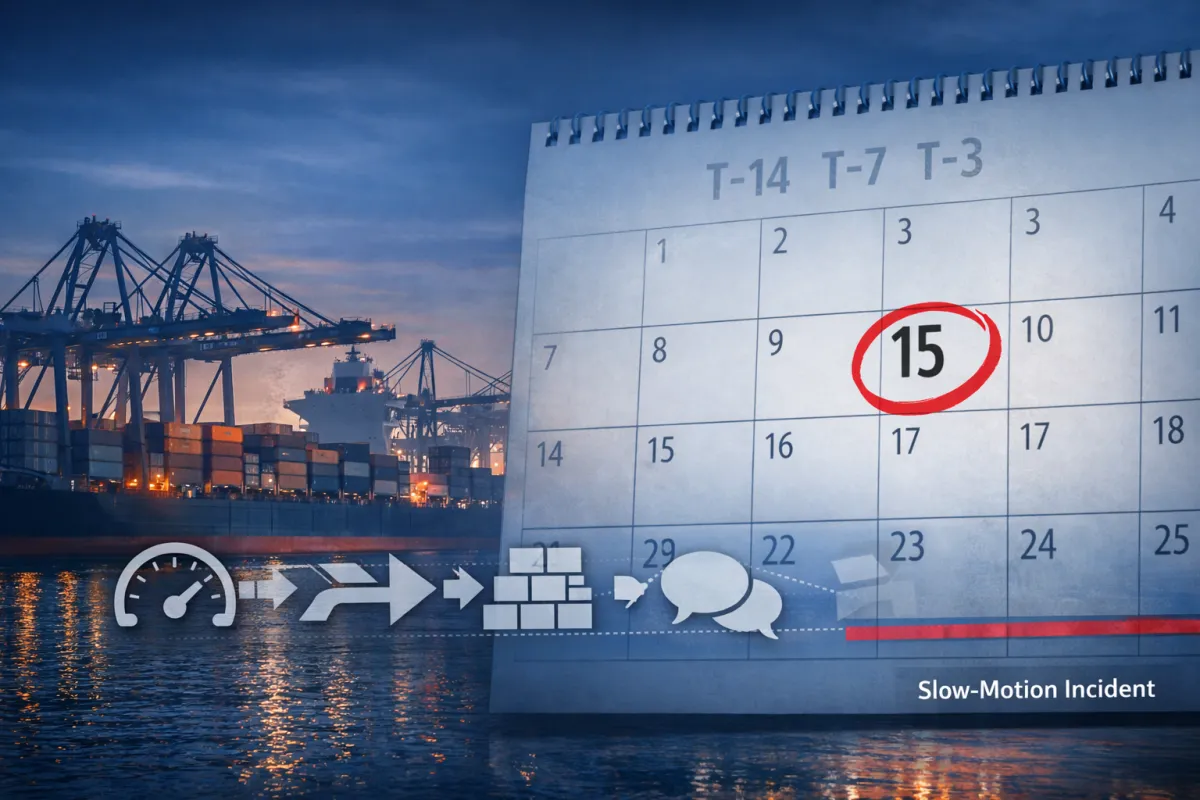
Port Strike Deadline: Slow-Motion Incident Planning
When the disruption has a countdown clock, the winners aren’t the fastest responders—they’re the earliest planners.
By Aaron Gilmore — Intergalactic SEM Consultant (humans only so far).
Human Lead, Automation-Enhanced. SEM-Artificium
QuickScan
A port strike deadline is a slow-motion incident: the timing window is forecastable even if the outcome isn’t.
Treat the deadline like a countdown operation: objectives, named owners, decision triggers, and a fixed communications cadence.
Use a P/A/C/E routing plan (Primary/Alternate/Contingency/Emergency) across ports, modes, and carriers—then validate constraints.
Protect mission-essential shipments and critical SKUs with pull-forward, capacity holds, and documented approvals.
Expect secondary risk spikes during reroutes (fraud, counterfeit substitution, compliance drift) and capture decision logs.
For Who Primary audience: DoD/Federal Supply Chain Best for roles: Logistics/Transportation, Contracting & Supplier Management, Continuity/COOP, Security/Program Management
What You’ll Get You will learn: How “deadline-driven disruptions” behave differently than surprise incidents—and how to plan the countdown.
You will be able to do: Build a one-page Countdown Card with triggers, protected shipments, routing options, and comms cadence.
Time & Effort Read time: 7–8 minutes
Do time (optional): 30–60 minutes
Difficulty: Intermediate
A strike deadline compresses decisions into a narrow window—countdown planning reduces cost, chaos, and surprises.
Executive Snapshot
What happened: A coastwide U.S. East and Gulf Coast port strike risk was tied to a hard deadline (Jan. 15, 2025) in ILA–USMX negotiations—creating a predictable, time-bounded disruption threat that prompted shippers to reroute, pull forward shipments, and build buffers. A tentative six-year agreement was announced Jan. 8, 2025, averting a Jan. 15 work stoppage pending ratification.
Why it matters: “Strike deadline” is a classic slow-motion incident: you can’t control the outcome, but you can forecast the impact window and execute mitigation steps on a countdown. Organizations that treat this like an incident (with objectives, triggers, owners, and comms cadence) reduce panic-buying, missed deliveries, and contract surprises.
Key lesson: When disruption is forecastable, resilience is a planning discipline—not a heroic response.
Field Notes Opening
Hurricanes give you a cone of uncertainty. Port strikes give you something more unsettling: a calendar date.
A deadline creates a strange psychological trap. People know what’s coming, so they wait—hoping the last-minute deal will arrive. Then, when the date gets close, everyone moves at once: carriers reposition, warehouses fill, and “plan B” becomes “plan now.”. That’s why port strike deadlines are one of the best training grounds for industrial security and emergency management leaders. They teach a transferable truth:
If you can see the incident coming, your job is to manage the countdown.
What We Know (Verified Facts)
A labor dispute involving the International Longshoremen’s Association (ILA) and the United States Maritime Alliance (USMX) created a strike risk across U.S. East and Gulf Coast ports tied to a Jan. 15, 2025 deadline.
Public reporting and industry analysis identified automation/modernization as a persistent sticking point, with high economic stakes tied to port throughput.
Georgia Tech commentary on the approaching deadline highlighted:
consumer impacts (availability concerns, including winter produce imports),
a tight logistics window around Chinese New Year (Jan. 25, 2025) affecting shipping schedules,
and common mitigation steps such as diversifying port usage, increasing inventory, and leveraging inland distribution networks.
On Jan. 8, 2025, ILA and USMX announced a tentative six-year master contract agreement, explicitly stating it would avert a Jan. 15, 2025 work stoppage, subject to ratification.
What We Don’t Know Yet (Unverified / Evolving)
Full details and long-term performance implications of the agreement (terms, enforcement mechanics, modernization timelines).
The residual risk of future labor actions during the contract period or at other nodes (rail, trucking, key overseas ports).
The true “cost of mitigation” absorbed by shippers (expedites, rerouting, inventory carrying cost, service degradation) vs. the avoided loss.
Timeline
Sep. 30, 2024: Prior ILA–USMX contract period ends (risk of disruption increases).
Oct. 1–3, 2024: A brief coastwide strike/stop-work period occurs and is then paused as parties reach a temporary settlement and extend the timeline.
Late 2024: Contract extension keeps ports operating while negotiations continue; Jan. 15, 2025 becomes the next “hard date.”
Jan. 8, 2025: ILA–USMX announce a tentative agreement, stating it averts a Jan. 15 work stoppage pending ratification.
Jan. 15, 2025: Deadline passes without a coastwide strike (based on the announced tentative agreement and continued operations under existing terms until ratification).
Why This Matters (So What?)
Operational impact:
Port strike risk drives routing volatility, warehouse congestion, container availability swings, demurrage/detention exposure, and “bullwhip” effects (over-ordering, then cancellations).
For mission-driven programs (DoD/Fed and critical suppliers), it can degrade:
readiness item deliveries,
spares replenishment,
depot/maintenance schedules,
and time-sensitive sustainment flows.

Figure 1 - "ILA–USMX Port Strike Risk Timeline (Oct 2024 → Jan 2025)" [Aaron Gilmore] {Simplified timeline of the Oct 2024 strike pause, contract extension to Jan 15, and tentative agreement announced Jan 8 that averted a work stoppage (Wiseman, 2025; United States Maritime Alliance & International Longshoremen’s Association, 2025).}
Risk / threat implications:
A strike deadline concentrates risk into a narrow window—perfect conditions for opportunistic fraud, counterfeit substitution, and rushed vendor onboarding.
It also increases cyber/operational exposure as organizations execute rapid changes (new carriers, new routes, new systems handoffs).
Governance / compliance implications:
Contract delivery clauses, force majeure interpretation, notification requirements, and performance SLAs come under stress.
Who should care most (roles/stakeholders):
Contracting & supplier management, logistics/transportation, mission assurance/continuity, customer delivery owners, and executive risk owners.
SEM Doctrine Translation
Doctrine focus:
Disruption forecasting + trigger-based planning (a.k.a. “countdown operations”)
Alternate routing + stakeholder communications as continuity controls
Plain-English explanation
A “slow-motion incident” is an event where the disruption is plausible and the timing is partially knowable—so the most important decisions happen before service is interrupted. Port strike deadlines are slow-motion incidents because the hazard is not a surprise; what’s uncertain is the outcome.
High-maturity organizations treat this like an incident management cycle: define objectives (protect life/safety, maintain essential deliveries, preserve customer trust), assign owners, set decision triggers, and execute comms on a cadence. Instead of asking “Will it happen?”, they ask “If the probability rises above X by date Y, what do we do?”
This is where business impact analysis (BIA) becomes operational: you identify which mission threads fail first, and what minimum service you must preserve. Then you implement continuity controls: alternate routing, inventory buffers for critical items, and supplier/customer messaging that prevents panic and rumor.
Controls / practices that apply:
Build a strike deadline dashboard (negotiation status, port congestion, vessel schedules, inventory position, customer delivery risk).
Establish decision triggers (e.g., probability thresholds, booking cutoff dates, warehouse capacity thresholds).
Implement a P/A/C/E routing plan (Primary/Alternate/Contingency/Emergency) across ports, modes, and carriers.
Prioritize critical SKUs/mission-essential shipments for pull-forward and protected capacity. - Pre-stage customer/supplier comms: cadence, channels, scripts, escalation rules.
Document rapid changes to prevent secondary risks (fraud, counterfeit, compliance drift).
Run a tabletop: “T-14 days to deadline” decision-making drill.
Scope boundaries (what this incident does NOT prove):
A port strike deadline does not mean a strike will occur, and it does not validate any single modernization or labor position.
It does not replace broader resilience work for other chokepoints (rail, trucking, overseas canals, cyber outages).
Lessons Learned (What this incident teaches)
Lesson 1: A deadline is a warning signal—use it to execute planned triggers, not improvised heroics.
“We’ll wait and see” compresses decisions into the last days, when capacity is scarce and costs spike. Countdown planning makes mitigation cheaper and calmer.
Lesson 2: Alternate routing is not a plan unless it is booked, tested, and communications-ready.
Organizations often list alternates but don’t validate constraints (capacity, inland drayage, customs, warehouse throughput). A real plan includes owners, reservations, and “how we will explain the change.”
Lesson 3: Customer trust is preserved by cadence and clarity more than certainty.
In slow-motion incidents, the public and customers tolerate uncertainty when updates are predictable and actions are clear.
Role-Based Implications (Who should do what)
Leadership / Executives:
Assign a single risk owner for strike-deadline decisions.
Approve the cost tradeoffs (inventory carrying vs. expedite vs. service degradation).
Security (physical/corporate) / Program Management:
Monitor secondary risks during rapid supplier/carrier changes (fraud, theft, counterfeit, access creep).
Ensure decision logs and approvals are captured for governance.
Emergency Management / Resilience / Continuity:
Treat strike deadlines as “planned disruption exercises.” and be happily surprised if they do not occur.
Define minimum-service operating modes for logistics and customer delivery.
IT/Cyber / Systems Security (if applicable):
Validate security of new integrations and data exchanges (new forwarders, portals, EDI changes).
Watch for phishing and vendor impersonation during high-pressure rerouting.
HR / Workforce / Insider Risk (if applicable):
Manage surge staffing, overtime, and fatigue risks in warehouses and transport ops.
Legal / Compliance / Contracts / Supply Chain (if applicable):
Pre-clarify contract language: notification windows, substitution rights, SLAs, force majeure triggers.
Ensure supplier comms are consistent and documented.
Facilities / Operations:
Confirm storage capacity, staging plans, and receiving throughput for pull-forward inventory.
Prepare for congestion (yard, dock doors, appointment systems).
What To Do Now (Field Application)
Immediate Actions (24–72 hours)
Action 1: Build the Countdown Card.
Deadline date + internal decision dates (T-30, T-14, T-7, T-3).
Owners for routing, inventory, customer comms, supplier comms, and approvals.
Action 2: Identify “Protected Shipments.”
Top 20 SKUs/mission threads that cannot slip.
For each: preferred port/mode + alternate + contingency.
Action 3: Create a communications cadence.
Internal update: daily at a fixed time when within T-14.
Customer update: weekly until T-14, then twice weekly (or as contract requires).
Evidence to capture (what to document/log):
Decision triggers used, routing changes, inventory moves, customer notices sent, and exceptions approved.
“Done” criteria:
A named owner can explain (in 60 seconds) what happens at T-14 and T-7, which shipments are protected, and where official updates are posted.

Figure 2 - "Slow‑Motion Incident Countdown Card (Port Strike Deadline)" [Aaron Gilmore] {One-page Countdown Card template showing decision triggers (T‑30 to T‑3), protected shipments, P/A/C/E routing options, communications cadence, and approvals/evidence capture.}
Short-Term Actions (This week)
Action 1: Run a “T-14 days to deadline” tabletop.
Injects: capacity shortage, warehouse saturation, counterfeit offer, customer escalation.
Action 2: Validate alternates.
Call carriers/forwarders; confirm booking cutoffs and inland capacity; test data handoffs.
Note from the Author
Slow-motion incidents are gifts—rare warnings in a world of surprises. If you can see the disruption coming, your job is to turn anxiety into a schedule: triggers, owners, and calm communications. In the case of labor disputes, its best to plan for them to happen and be surprised if they don't. Clearly in this case the port agreed to terms that addressed grievances the laborers requested, so blaming employees who have grievances in not the right answer ever. Instead of shifting blame, remember legally the responsibility is in decision makers when incidents of this caliber occur. If a port of this size were to catastrophically fail because of a labor dispute, it would be management/leadership on the legal chopping block for letting it happen, not the laborers for exercising their rights to strike based on grievances....
Reference List
Georgia Institute of Technology. (2025, January 8). Race against time as port strike threatens supply chain stability. Georgia Tech News. https://news.gatech.edu/news/2025/01/08/race-against-time-port-strike-threatens-supply-chain-stability
Mirage News. (2025, January 9). Port strike looms, supply chain stability at risk (reprint of Georgia Institute of Technology release). https://www.miragenews.com/port-strike-looms-supply-chain-stability-at-risk-1388057/
United States Maritime Alliance (USMX) & International Longshoremen’s Association (ILA). (2025, January 8). Joint statement: Tentative agreement reached on new six-year ILA–USMX Master Contract (PDF). https://usmx.com/assets/content/public-resources/1-8-2025_ILA-USMX_JOINT_STATEMENT_Tentative_Agreement_Reached_on_New_Master_Contract.pdf
Whitlock, B. (2024, October 4). How U.S. port strikes disrupt supply chains. Gartner.
1.https://www.gartner.com/en/articles/how-us-port-strikes-disrupt-supply-chains
Maersk. (2025, January 9). Update on ILA–USMX tentative agreement and potential impact. https://www.maersk.com/news/articles/2024/12/12/ila-usmx-negotiations
National Institute of Standards and Technology. (2025, February). Using Business Impact Analysis to Inform Risk Prioritization and Response (NIST IR 8286D-upd1). https://nvlpubs.nist.gov/nistpubs/ir/2025/NIST.IR.8286D-upd1.pdf
National Institute of Standards and Technology. (2022, May). Cybersecurity Supply Chain Risk Management Practices for Systems and Organizations (NIST SP 800-161r1). https://nvlpubs.nist.gov/nistpubs/SpecialPublications/NIST.SP.800-161r1.pdf
International Organization for Standardization. (2019). ISO 22301:2019 — Security and resilience — Business continuity management systems — Requirements. https://www.iso.org/standard/75106.html
Federal Emergency Management Agency. (n.d.). Incident Action Planning Process (“The Planning P”) (PDF). https://training.fema.gov/emiweb/is/icsresource/assets/incident%20action%20planning%20process.pdf