



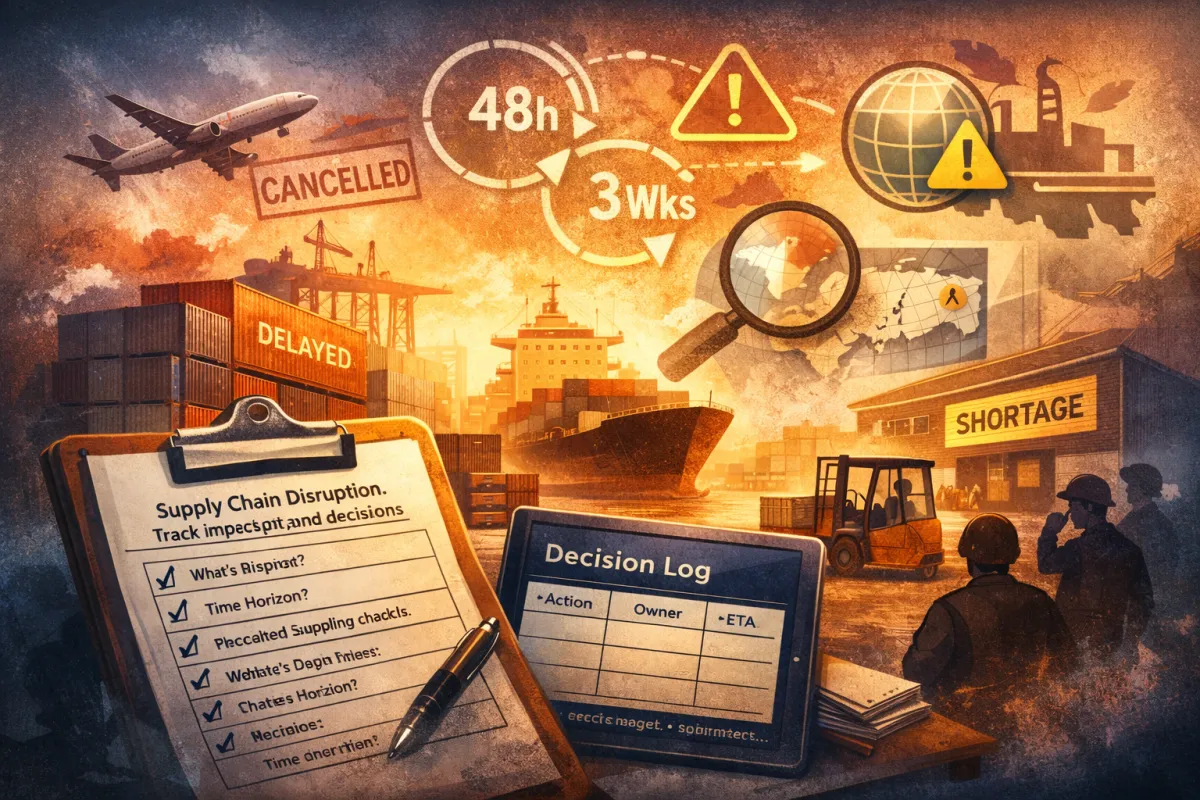
Supply Chain Disruption: 8 Questions in 15 Minutes
When disruption hits, speed and clarity beat perfect data. These eight questions turn chaos into decisions, owners, and an update cadence.
By Aaron Gilmore — Intergalactic SEM Consultant (humans only so far).
Human Lead, Automation-Enhanced. SEM-Artificium
QuickScan
Don’t start with “What happened?” Start with “What’s impacted and for how long?”
The goal of the first 15 minutes is a shared picture: impact, options, constraints, owners, next update.
Write answers down. Your “decision log” becomes your continuity backbone.
Repeat the questions at each update cycle; change decisions as the picture improves.
For Who
Primary audience: Non-DoD / Non-Federal supply chain organizations (ops + procurement + leadership)
Best for roles: Operations/COO, procurement/supply chain, logistics, risk/compliance, finance, legal/contracts, customer success/sales
What You’ll Get
You will learn: A rapid disruption triage framework that works across most disruption types.
You will be able to do: Run a 15-minute disruption huddle and produce immediate next actions.
Time & Effort
Read time: 5 minutes
Do time (optional): 20–45 minutes (turn this into a one-page worksheet + run a tabletop)
Difficulty: Beginner
Turn disruption signals into decisions fast—capture impact, time horizon, options, owners, and the next update.
Quick Brief Snapshot
One-sentence answer: Use eight rapid questions to convert disruption uncertainty into decisions: impacted products, time horizon, inventory, alternatives, constraints, customers, owners, and next update.
Why this matters: In the first 15 minutes, speed + shared clarity beats perfect data. If you don’t force a structured huddle, you’ll get parallel work, contradictory customer messaging, and late surprises (the “first failure” item you didn’t track).
Key takeaways
Start with impact + time horizon, not root-cause detective work.
Use best / likely / worst ranges to stop false precision.
Write it down: the decision log becomes your continuity backbone.
End every huddle with owners + next update time (cadence is control).
The Concept: A 15-Minute Disruption Huddle (With a Decision Log)
Think of supply disruption like a mini-incident: you need a shared picture, a decision, and a rhythm.
The job of the first 15 minutes
Define what’s disrupted (one node vs. multiple).
Identify what breaks first (the first failure point).
Pick 1–3 viable moves (and what blocks them).
Assign owners and set the next update.
Minimum roles (keep it small)
Ops leader (decision authority)
Procurement/supply chain
Logistics/transport (if separate)
Finance (cost tradeoffs)
Sales/customer success (customer impact + timing)
Risk/compliance/legal (only if constraints are likely)
Rules of the huddle (non-negotiable)
Time-box answers. Park debates as follow-ups with an owner.
Use ranges, not “Tuesday at 2pm” confidence theater.
One action = one owner. Define “done.”
Set the next update time before you end.
A Simple Example
A port delay + customs backlog hits a critical component. No one knows if it’s 48 hours or 3 weeks.
In the huddle, you ask the questions in order:
Q2 reveals the real risk: two SKUs fund your weekly revenue target, and they share the same constrained part.
Q4 shows you have 7 days on hand for the constrained part, but only 2 days for a related packaging item.
Q5 surfaces options: expedite a partial shipment, switch to a pre-qualified alternate supplier, or temporarily reduce product mix.
Q6 flags constraints: alternate supplier requires a quality sign-off; a spec change requires a customer approval.
Q7 sets comms: customer success drafts a controlled message for “possible delivery changes” while legal checks contract language.
Result: you don’t “solve the disruption” in 15 minutes—you produce a minimum viable decision log and a cadence. That’s what keeps operations stable while facts catch up.
Practical Checklist
Do this today (next disruption or tabletop)
Stand up the 15-minute huddle (roles above).
Ask the 8 questions in order (below).
Produce a Minimum Viable Decision Log:
Impact summary (what/where/when)
Time horizon (best/likely/worst)
1–3 candidate options (and constraints)
Owners + due times
Next update time (cadence)
Comms plan (internal + customer/partner if needed)
Pick the decision pattern you’re using right now (name it out loud):
Buy time: expedite, allocate inventory, reduce product mix, temporary substitutions
Switch sources: alternate suppliers, spot buys, temporary contract adjustments
Reduce dependency: redesign/re-spec, future safety stock, dual-source
The 8 Questions (ask in this order)
What’s disrupted? (supplier/route/material/geopolitical/labor/cyber event)
What products/operations are impacted? (SKUs/services/sites/customers) What fails first?
How long could it last (best/likely/worst)?
What inventory do we have (days on hand)? Any spoilage/expiration constraints?
What are our alternatives? (suppliers/routes/modes/substitutes/prioritization)
What constraints apply? (quality, compliance, contracts, safety, customer approvals)
Who must we notify? (internal, customers, regulators, insurers as applicable)
Who owns next actions—and when is the next update?
Do this this week (build resilience after the first fire)
Identify your top single-source dependencies and the “first failure” items.
Build/refresh approved alternates (suppliers, routes, substitutions) before you need them.
Improve inventory visibility for critical items (days-on-hand is the executive metric).
Pre-write customer comms templates for delays and allocation.
Maintain a supplier escalation contact list and disruption intake script.
Tie it into continuity and supply chain risk practices (e.g., critical dependency identification and response options). (NIST, 2022)
Evidence to capture (so you can defend decisions later)
Decision log: what you decided + why + who owns it + revisit time
Inventory snapshots used for decisions (timestamped)
Supplier confirmations (ETAs, constraints, partial shipment options)
Constraint approvals (quality/compliance/customer sign-offs)
Communications log (what was said, to whom, when)

Figure 1 - "8 Questions Rapid Assessment Worksheet (In-Body)" [Aaron Gilmore] {Worksheet template with eight labeled fields for disruption triage, plus actions/owners and next update time.}
Common Pitfalls (Avoid These)
Starting with root cause instead of impact + time horizon (you lose time and alignment).
Arguing about exact dates instead of using best/likely/worst ranges.
No owner per action (“everyone is on it” = no one is on it).
Switching suppliers without constraints (quality/compliance/customer approvals get skipped).
Late customer comms (customers discover delays from the dock, not from you).
No cadence (updates happen when someone remembers, not on schedule).
Note from the Author
Disruption is rarely solved fast, but it can be managed fast. The win is not predicting the future; it’s building a disciplined loop: ask the same questions, write decisions down, update as facts change, and keep your organization speaking with one voice. Supply chains exist in all companies, all industries and take both physical and non-physical forms. It's always the best choice to complete a "Risk Register" in addition to this rapid assessment worksheet, even if you only start with your supply chains. The 1st risk I always place is "A Zombie Apocalypse", to both get immediate feedback from leadership (by making them pay attention OR checking if they are paying attention) and show a serious example of how to demonstrate how to fil out a risk register. Although not covered in this article, when you pair a risk register WITH this simple rapid assessment worksheet, you begin to lay a foundation of Identification of the threats and edge cases that may threaten your supply chains, and mitigation plans to deal with all those risks and edge cases in the rare care they occur. an ounce of prevention is worth millions of dollars in damage to your company.
References
National Institute of Standards and Technology. (2022). Cybersecurity supply chain risk management practices for systems and organizations (NIST SP 800-161 Rev. 1). NIST Computer Security Resource Center. https://csrc.nist.gov/publications/detail/sp/800-161/rev-1/final
Federal Emergency Management Agency. (n.d.). Business continuity planning suite. U.S. Department of Homeland Security. https://www.fema.gov/emergency-managers/risk-management/business-continuity
International Organization for Standardization. (2019). ISO 22301:2019 — Security and resilience — Business continuity management systems — Requirements. ISO. https://www.iso.org/standard/75106.html